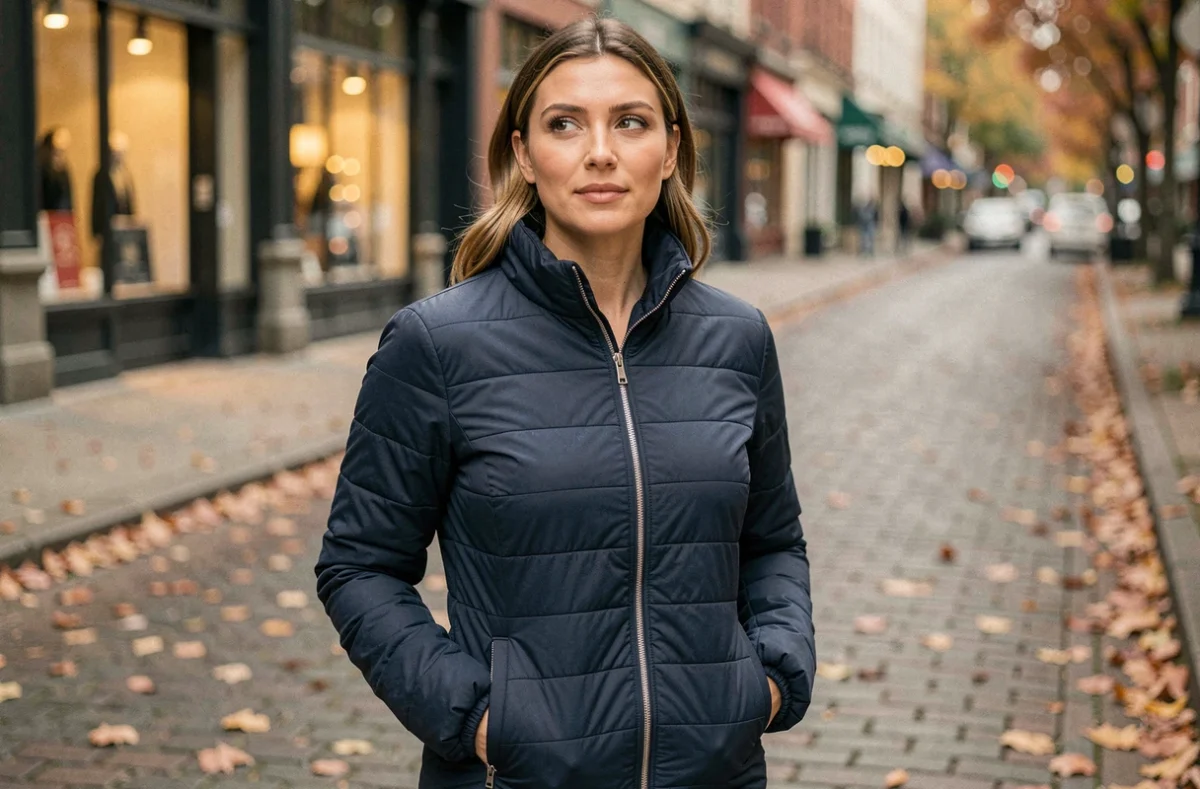
We head out in the morning for a trail in the mid-mountains, the weather forecast predicts 8 °C at the start and 2 °C at the pass. The bag is already full: windbreaker, poles, water bottle. The lightweight down jacket that we slip into the bottom must take up minimal space, weigh as little as possible, and warm up quickly when we stop. This scenario dictates almost all the criteria for choosing a lightweight down jacket for women, much more than color or current trends.
Down or synthetic insulation: what the terrain really demands
The first reflex is to compare down and synthetic on the label. On paper, down offers a better warmth-to-weight ratio. In real conditions, the situation becomes more complicated.
A down filling performs as long as it stays dry. As soon as it absorbs moisture (sweat under a backpack, persistent drizzle), it loses a significant part of its insulating power and takes a long time to dry. Synthetic insulation, like PrimaLoft, retains its insulating properties better even when wet. It also dries faster, which matters when you’re on multi-day hikes without access to a dryer.
For urban use or short outings in dry weather, down remains the most compact and warmest choice. For demanding activities in the mountains with a risk of rain, synthetic offers superior reliability. You can consult a guide to lightweight down jackets for women to refine this choice based on your usual program.
A rarely mentioned point: the loft power of down, expressed in cuin, directly affects compressibility. The higher the cuin, the less down is needed for equivalent warmth, and the more the jacket compresses small in the bag. If the manufacturer does not provide this information, it is often a bad sign.
Outer fabric and water-repellent treatment: the PFAS trap
Most lightweight down jackets receive a water-repellent treatment to make droplets bead on the surface. This treatment still often relies on PFAS, those persistent fluorinated compounds in the environment and in the body.
Checking for the absence of PFAS on a water-repellent down jacket has become a concrete criterion. French regulations set residual thresholds, but the label alone does not always confirm compliance. It is recommended to consult the detailed material sheet or the manufacturer’s declaration rather than relying solely on the word “water-repellent” on the packaging.
On the fabric side, we seek a compromise between abrasion resistance and lightness. A very thin fabric (like ultra-light ripstop) reduces weight but tears more easily when in contact with branches or rocks. For mountain use, prefer a slightly denser fabric. For the city, ultra-light fabric is suitable.
Fit and adjustment: choosing a women’s down jacket based on actual use
Competitors talk a lot about silhouette and style. In the field, the fit is primarily chosen based on what you wear underneath and on top.
Down jacket as a mid-layer
In the three-layer system (technical underwear, insulation, outer protection), the down jacket plays the role of insulation. It should have a fitted cut that slips under a hardshell jacket without creating annoying bulk. The sleeves should not ride up when you raise your arms. The length should stop at the hips.
Down jacket as an outer layer
Worn alone in the city or on a walk in cool, dry weather, the down jacket can be slightly looser. Check these points before buying:
- The hood, if it exists, should allow you to turn your head without the fabric following the movement. A hood that is too tight limits side vision.
- Pockets should be accessible with a backpack on your shoulders, so they should be placed high enough on the torso or chest.
- Elasticated hems at the wrists and bottom of the down jacket prevent cold air from creeping in, but a drawstring at the waist offers a better fit.
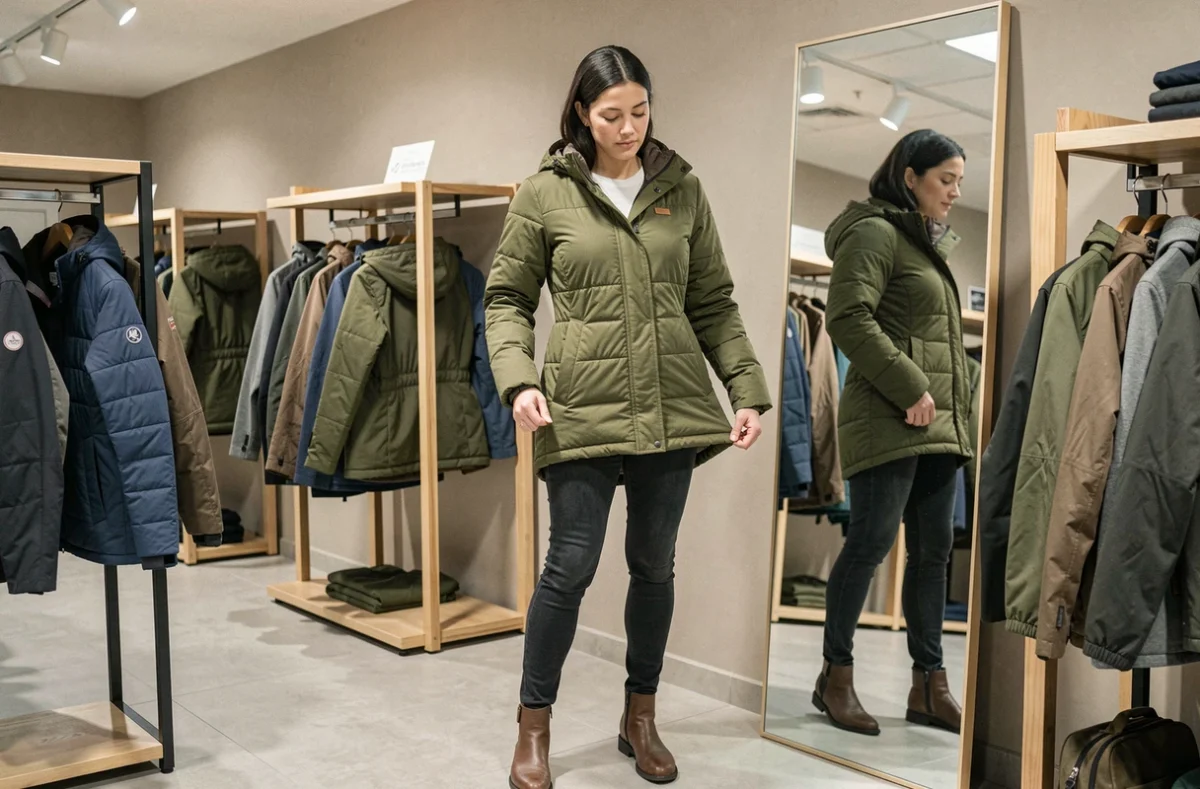
Feedback varies on the sizing issue: some brands fit tightly to promote compactness, while others allow space for layering. Trying it on with the layer you will wear underneath remains the most reliable method.
Durability and repairability: criteria that will weigh more and more
The European regulation on the eco-design of sustainable products, which came into effect on July 18, 2024, places textiles among the priority product groups. The 2025-2030 work plan adopted by the European Commission on April 16, 2025, sets requirements for durability, repairability, recycled content, and information provided to consumers.
In concrete terms, a future digital product passport will allow for comparing traceability and durability between two down jackets. In the meantime, we can already identify concrete indicators:
- Does the manufacturer offer a repair service or spare parts (zip sliders, fabric patches)?
- Is the filling made from recycled down or certified according to an animal welfare standard (RDS for example)?
- Does the product sheet explicitly mention the composition of the water-repellent treatment?
A repairable and well-documented down jacket often costs a bit more at purchase, but lasts several more seasons. This is a calculation to consider before rushing to the cheapest model.
Weight, compressibility, and storage: the details that change everything in the bag
On a day trip, every gram counts little. On a multi-day trek, the difference between a down jacket that compresses into its own pocket and one that takes up a third of the bag becomes a real issue.
Compressibility depends on the filling (high cuin down wins here), the outer fabric (thinner, more compressible), and the construction of the baffles. Welded baffles eliminate the weight of seams but create thermal bridges at the junctions. Sewn baffles with baffles limit these bridges at the cost of a few extra grams.
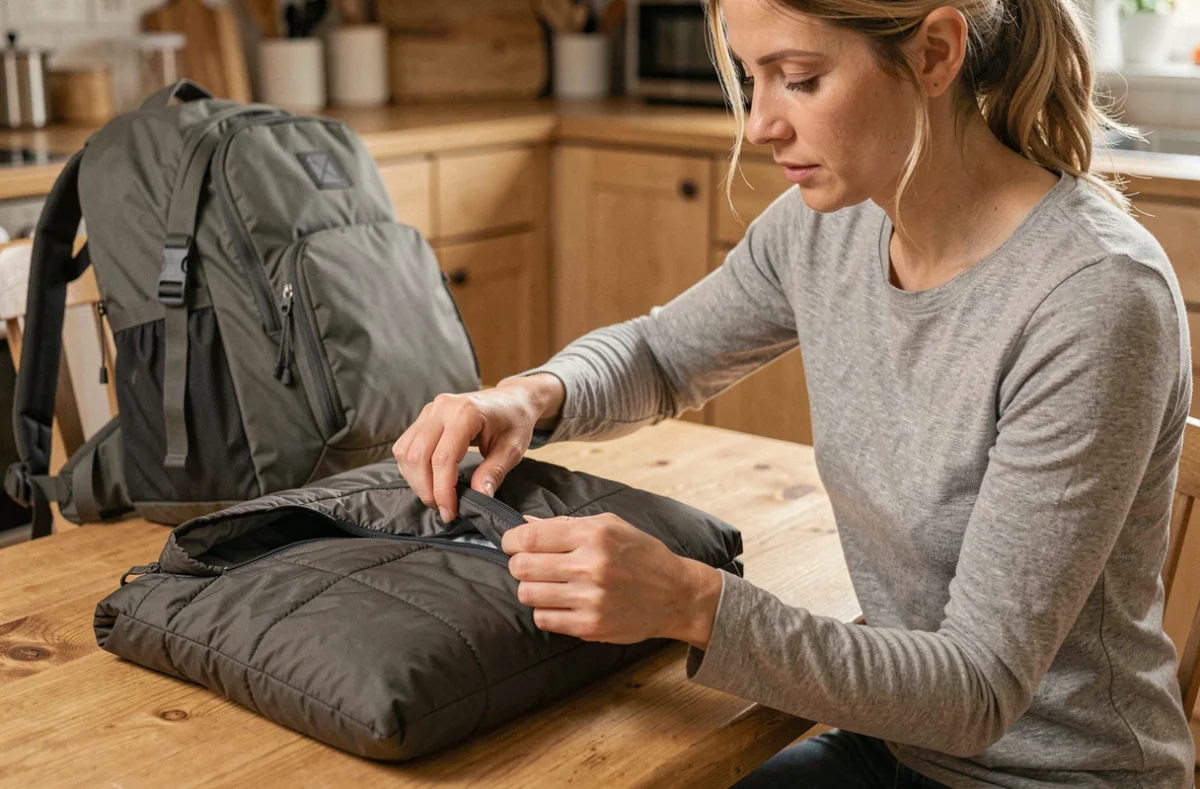
To check compressibility in-store, crumple the down jacket into a ball and see if it fits in one hand. If the manufacturer provides an integrated storage bag, it’s a good indicator of design thought for the field.
Choosing a lightweight down jacket comes down to three trade-offs: down or synthetic depending on exposure to moisture, fitted or loose cut depending on the role in the layering system, and level of finish (fabric, baffles, treatment) according to budget and intended duration of use. The rest is a matter of color.