The interior decoration market is undergoing a shift. After a decade dominated by white and gray minimalism, trends observed since 2024 point in the opposite direction: bold colors, thrifted objects, natural textiles.
Home decor is no longer just about choosing a sofa and two matching cushions. It reflects underlying movements related to the second-hand market, palettes dictated by color institutes, and the increasing integration of home automation in interiors.
Loud decorating and the end of all-white: what the chromatic shift reveals
The study “Pinterest Predicts 2025,” published by Pinterest at the end of 2024, documents a marked increase in searches related to loud decorating: bold colors, assertive patterns, accumulation of characterful objects. This shift is not merely a seasonal trend.
It reflects a measurable weariness with minimalist interiors, where each room looked like the next. Uniform beige living rooms are giving way to deep blue painted walls, mustard velvet armchairs, and layered rugs.
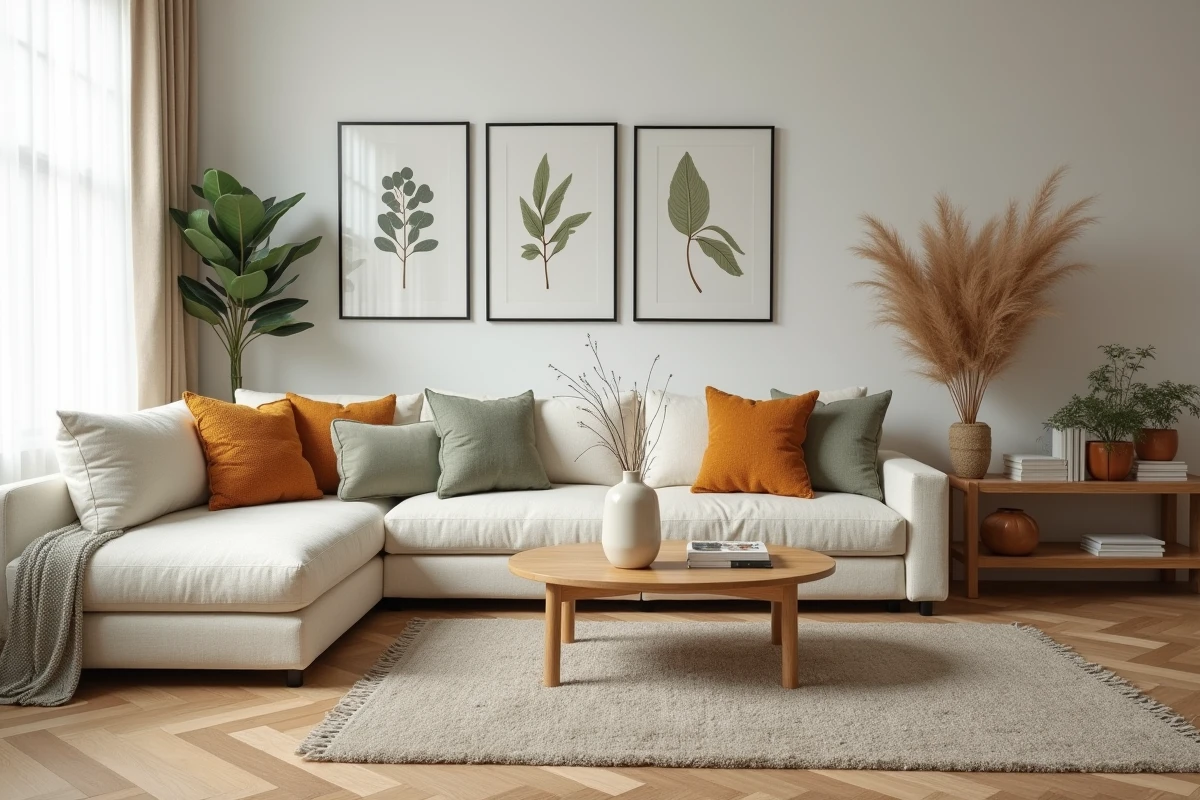
At the same time, several color institutes (Pantone, AkzoNobel, Dulux Valentine) are converging around soothing shades inspired by nature for 2024-2025: misty blues, sage greens, earthy neutrals. The nuance lies in the combination. A sage green wall works with light wood furniture and linen textiles but produces a dull result with metallic gray furniture.
The trend, for those wishing to discover decor on Direct Maison, encourages thinking in terms of a global palette (walls, textiles, furniture, lighting) rather than an isolated color applied to a single wall.
Home decor and second-hand: a market restructuring choices
FEVAD notes in its 2024 report a marked growth in peer-to-peer resale platforms in the home and decor categories. This data changes the way interiors are conceived.
Buying a 1960s sideboard on a resale platform is no longer an act of activism or Sunday DIY. It has become a common purchasing reflex, driven by an abundant supply and often lower prices than entry-level new items.
What second-hand changes in the composition of an interior
A living room decorated solely with new furniture from the same brand produces a recognizable catalog effect. Mixing vintage pieces with targeted new purchases creates a unique visual identity for each interior. A thrifted solid oak coffee table, paired with a contemporary sofa and designer lighting, generates a contrast that all-new cannot achieve.
Field reports diverge on this point: some professional decorators believe that mixing eras requires a trained eye to avoid a hodgepodge, while others consider that imperfection is part of the charm. The only consensual rule remains the coherence of the color palette between different rooms.
- Check the structural condition of the furniture (legs, drawers, seating) before purchase, as aesthetic patina does not guarantee sturdiness
- Favor durable materials (solid wood, metal, rattan) that withstand the passage of time and restorations
- Limit impulsive purchases by first defining the missing volumes in each room (seating, storage, surface area)
Connected lighting and home automation: the concrete impact on interior decoration
Players in home automation and lighting, notably Philips Hue (Signify) and Ikea, are now integrating color temperature and intensity variation functions into their consumer ranges. This technical evolution has a direct effect on home decor.
The same living room radically changes atmosphere depending on the programmed light temperature. A cool white light at 5,000 K gives a clinical rendering, while a setting at 2,700 K produces a warm ambiance. Decoration is no longer limited to objects visible in daylight.
Integrating light as a decorative element in its own right
The choice of a light fixture is no longer reduced to its shape. Its ability to modulate the ambiance of a room depending on the time of day becomes a selection criterion on par with its design. LED strips hidden behind furniture or under a shelf create depth effects impossible to achieve with a traditional ceiling light.
The available data does not yet allow for precise measurement of the impact of home automation on the decoration budgets of French households. However, the offer has become so democratized that connected bulbs are now available at prices comparable to standard LED bulbs.
Natural materials and textures: wood, linen, stone in trendy decor
The return of raw materials in interior decoration is not new, but its current scale deserves attention. Wood (oak, walnut, ash), linen, natural stone, and stoneware compose a palette of textures that harmonizes with the natural shades promoted by colorists.
- Light wood (bleached oak, ash) pairs with sage greens and off-whites for a bright living room without falling into coldness
- Raw linen (curtains, cushions, tablecloths) brings a matte texture that contrasts with the smooth surfaces of modern furniture
- Natural stone (travertine, terrazzo) in small touches (tabletop, vase base) is enough to ground an interior without weighing down the budget
- Stoneware and artisanal ceramics, in vases or displayed tableware, add a tactile dimension that plastic or industrial glass cannot replicate
The coherence of textures is as important as that of colors. An interior that mixes too many smooth surfaces (glass, lacquered, polished metal) lacks warmth. Conversely, an excess of raw materials (wood everywhere, linen everywhere) can produce an unintentional rustic effect.
Current home decor is built on finer trade-offs than it was ten years ago. Inspirations abound, from loud decorating, thrifted furniture, to modular lighting. The common thread remains the coherence between color palette, textures, and light sources, three parameters that each room in the house requires adjusting separately.