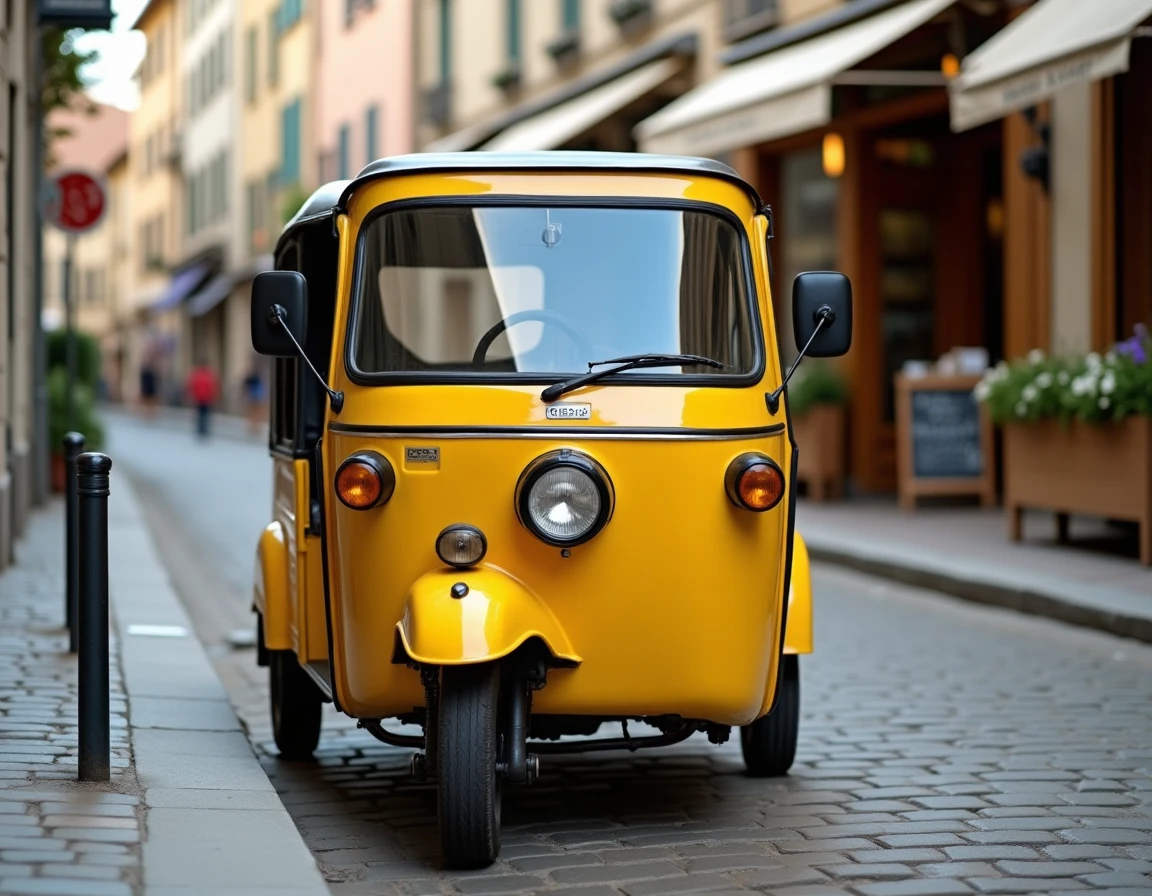
A Marseille, a restaurateur who wants to deliver meal baskets in the Old Port, and a tourism provider in Bordeaux offering guided tours: both must go through the same administrative process before putting a tuk tuk on the road. Although the vehicle may seem simple, the French legal framework treats it with the same rigor as a VTC or taxi as soon as it transports passengers for a fee.
Here, we focus on the real constraints faced by a tuk tuk buyer in France, the often underestimated costs, and the central question: can this type of vehicle generate a viable income in the territory.
Insurance and technical control of the tuk tuk: the hidden costs of operation
The first surprise often comes when looking for an insurance contract. A tuk tuk, whether thermal or electric, does not fit into the usual categories of auto insurers. Generalist companies regularly refuse to cover a motorized tricycle or offer increased rates due to a lack of statistical data on claims.
For professional use (passenger transport, delivery), a specific professional liability insurance is mandatory, in addition to the vehicle’s insurance itself. We are therefore talking about two distinct contracts, with deductibles and limits to negotiate with brokers specializing in atypical fleets.
On the maintenance side, recent legislative tracks emphasize a strengthened periodic technical control for motorized tricycles. This point is rarely mentioned by dealers, but it weighs on the annual budget. Before signing an order form, it is recommended to estimate all these items with an accountant familiar with niche vehicles. When considering the purchase of a tuk tuk in France, these recurring expenses determine the project’s viability as much as the purchase price.

Can a tuk tuk really be profitable in France?
Profitability depends on a parameter often overlooked: the versatility of the activity. Operators who survive beyond two seasons almost never do just one thing with their vehicle.
Successful combinations in the field
Feedback varies on this point, but a common pattern emerges among active operators:
- Tourism in high season (guided tours, heritage circuits) combined with rentals for corporate seminars the rest of the year
- Mobile advertising, where the tuk tuk serves as a rolling communication platform for local brands, generating a fixed monthly income independent of the weather
- Urban delivery over short distances, especially in low-emission zones where the electric tuk tuk can operate without restrictions
Diversification is the condition for the economic survival of a professional tuk tuk in France. A single-activity operator (tourism only, for example) suffers from seasonality and struggles to cover fixed costs between October and March.
The issue of parking and recharging
For electric vehicles, the question of daily recharging becomes very concrete. Few public charging stations are designed for a tricycle that does not fit the dimensions of either a cargo bike or a car. Many operators recharge at home or in a dedicated location, which requires an investment in infrastructure.
Parking in city centers remains a headache. Public policies have not yet provided specific spaces, and a tuk tuk parked in a car space may receive a fine depending on the municipality. Some operators negotiate agreements with private parking lots, but this adds an additional cost line.
Legal status of the tuk tuk in France: an unstable framework
The current regulatory framework treats the tuk tuk as a three-wheeled vehicle subject to the regime for passenger transport. In practice, operating a tuk tuk for paid transport requires the same prefectural authorizations as a VTC.
A senatorial bill proposed in 2022 and revised in committee in 2024 aims to create a specific status distinct from VTC and chauffeur-driven bicycles. This text has not yet been adopted, placing buyers in a zone of uncertainty: the rules may change in the coming months.
Homologation and permits: what to check before purchase
Importing a tuk tuk from Southeast Asia and registering it in France is an obstacle course. Compliance with European standards (braking, lighting, emissions) often costs as much as the vehicle itself.
Buying a model already homologated by an approved importer remains the only realistic option for most project holders. The few distributors present in the French market offer tricycles compliant with regulations, with a registration certificate that can be issued directly.
The required license depends on the engine size and power of the vehicle. A Class B license is sufficient in most cases for the electric models sold in France. For more powerful thermal versions, a motorcycle license may be required.
Tuk tuk and low-emission zones: a concrete but limited advantage
Low-emission zones (LEZ) are multiplying in French metropolitan areas. An electric tuk tuk can operate there without restrictions, giving it an advantage over thermal delivery or tourist transport vehicles.
This advantage has its limits. The maximum speed of a tuk tuk, generally capped well below that of a car, prohibits any circulation on highways or ring roads. The range remains confined to the city center, which suits urban tourism but excludes intercity connections.
The sustainable mobility package may, in some cases, include a registered electric tuk tuk considered equivalent to an electric-assisted bike taxi. This possibility, opened by decrees in 2020 and supplemented in 2022 and 2023, mainly concerns public and private employers who reimburse part of their employees’ commuting trips.

The tuk tuk market in France remains a niche sector where profitability relies on diversification, control of insurance and maintenance costs, and a good understanding of a legal framework that has yet to evolve. Successful project holders are those who treat their tuk tuk as a professional multi-use tool, not as a seasonal attraction.